Monday, 13 February 1995

The Importance of Being Earnest written by Oscar Wilde and premiered at St. James's Theatre, London, on February 14, 1895

   A scene from The Importance of Being Earnest written by the Irish playwright Oscar Wilde (1854 - 1900) and produced, under the direction of  George Alexander with designs by H. P. Hall and Walter Hann, at St. James's Theatre, London, having run shorter than expected, due to Oscar Wilde's increasing public notoriety, from February 14 to  May 8, 1895.

   The original cast featured George Alexander as 'John Worthing', Allan Aynesworth as 'Algernon Moncrieff', Rose Leclercq as 'Lady Bracknell', Irene Vanbrugh as 'Gwendolen Fairfax', Evelyn Millard as 'Cecily Cardew', Mrs. George Canninge as 'Miss Prism', H. H. Vincent as 'Rev. Canon Chasuble', F. Kinsey Peile as 'Lane' and Frank Dyall as 'Merriman'. 


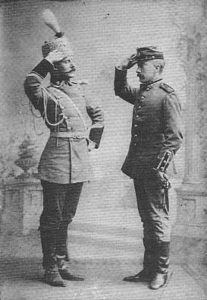
Allan Aynesworth as Algernon (left) and George Alexander as John (right)


Irene Vanbrugh as Gwendolen Fairfax and George Alexander as Jack Worthing in the 1895 production


Allan Aynesworth, Evelyn Millard, Irene Vanbrugh and George Alexander in the 1895 premiere


Mrs George Canninge as Miss Prism and Evelyn Millard as Cecily Cardew


"The Illustrated Sporting and Dramatic News, March 23rd, 1895, The Importance of Being Earnest at the St. James's Theatre."
1- Cicely- "The next day i bought the little ring in your name."
2- Mrs. Prism.- "Poor Earnest!  it's a sad blow."
3- John Worthing- "I suppose a man may eat his own muffins in his own garden."
4- Gwendolen- "My first impressions of people are never wrong."


OSCAR WILDE'S THE IMPORTANCE OF BEING EARNEST. A Reconstructive Critical Edition of the Text of the First Production, St James's Theatre, 1895.


Gwendolen (Irene Vanbrugh), Merriman (Frank Dyall) and Cecily (Evelyn Millard), in the original production, Act II


Known as Wilde's most famous play, The Importance of Being Earnest premiered at St. James's Theatre in London on 14 February 1895. Wilde began meticulously outlining and drafting the comedy in July 1894. He continued revising the play over the course of six months.


See More about this Play

Wednesday, 9 March 1994

Go-Bang, produced by Fred Harris and opened at the Trafalgar Square Theatre on 10 March 1894.

Some scenes from Go-Bang, produced by Fred Harris and opened at the Trafalgar Square Theatre on 10 March 1894. The play ran for 159 performances. 

Go-Bang is an English musical comedy with words by Adrian Ross and music by F. Osmond Carr.


The Sketch, April 11th, 1894, "Go-Bang," at the Trafalgar Theatre.
   a- Mr. Sidney Howard (Guardian of the Golden Canopy).
   b- Mr. Harry Grattan (Jenkins) and Miss Adelaide Astor (Sarah Anne).
   c- Mr. Grattan, Mr. G. Grossmith, jun. (Lieut. the Hon. Augustus Fitzpoop), and Miss Astor.
   d- Mr. Arthur Playfair (Sir Reddan Tapeleigh, K.C.S.I.), Mr. J. L. Shine (The Boojam), and Mr. Frederick Rosse (Narain).


The Sketch, April 11th, 1894, Miss Jessie Bond as Helen Tapeleigh in "Go-Bang," at the Trafalgar Theatre."


The Sketch, April 11th, 1894, "Miss Letty Lind in "Go-Bang," at the Trafalgar Theatre.


The Sketch, June 12th, 1895, "Miss Maud Maude in "Baron Golosh," at the Trafalgar Theatre.

Friday, 10 December 1993

A Woman Of No Importance written by Oscar Wilde (1854 – 1900), and produced at the Miner's Fifth Avenue Theatre, New York, from December 11, 1893 to Jannury 1, 1894,.

A scene from A Woman Of No Importance written by the Irish playwright Oscar Wilde (1854 – 1900), and produced at the Miner's Fifth Avenue Theatre, New York City, from December 11, 1893 to Jannury 1, 1894, starring Maurice Barrymore and Rose Coghlan.

MB: American actor, 21 September 1849 – 26 March 1905. 
RC: Irish actress, 18 March 1851 - 2 April 1932. 

New York Times: Her Capable and Sincere Acting in the New Play by Oscar Wilde, "A "Woman of No Importance," at the Fifth Avenue Theatre -- Maurice Barrymore's Lamentable Inefficiency -- "Zamar," a...


Thursday, 2 September 1993

Der Biberpelz (1893) written by Gerhart Hauptmann and produced at the Deutschen Theater Berlin with Else Lehmann as Frau August Wolff in September 1893

A scene from Der Biberpelz (1893) written by the German playwright Gerhart Hauptmann (1862 - 1946)  and produced at the Deutschen Theater Berlin with Else Lehmann (German theatre actress, 1866 - 1940) as Frau August Wolff in September 1893.


Friday, 28 May 1993

Programme for The Weavers (Les tisserands) written by Gerhart Hauptmann and produced at the Théâtre Libre, Paris, on May 29, 1893

Programme for The Weavers (Les tisserands) written by the German playwright Gerhart Hauptmann (1862 - 1946) and produced at the Théâtre Libre, Paris, on May 29, 1893.


Monday, 19 October 1992

The Inspector General (1836) written by Nikolai Vasilievich Gogol and produced at the Moscow Art Theatre in 1892

A scene from The Inspector General (Ревизор, first performed in 1836) written by the Russian playwright Nikolai Vasilievich Gogol (1809-1852) and produced at the Moscow Art Theatre in 1892.


Thursday, 20 February 1992

Lady Windermere's Fan (a four-act play) written by Oscar Wilde (1854-1900) and first performed on Saturday, 20 February 1892, at the St James's Theatre in London.

Scenes from Lady Windermere's Fan (a four-act play) written by the Irish playwright Oscar Wilde (1854-1900) and first performed on Saturday, 20 February 1892, at the St James's Theatre in London.

 the first production and cast of 'Lady Windermere's Fan' (1892) 


1892 premiere: left to right, Ben Webster (Cecil Graham), Nutcombe Gould (Lord Darlington), Adolphus Vane-Tempest (Charles Dumby), H. H. Vincent (Lord Augustus Lorton) and George Alexander (Lord Windermere)


English actress Marion Terry (1852 - 1930) as Mrs Erlynne in a production of 'Lady Windermere's Fan' by Oscar Wilde, at the St James's Theatre in London, 1892. 


Winifred Emery as Lady Windermere, 1892


First Night - St. James's Theatre,
London, 1892. 


FOR YOUR REFERENCE:
On Saturday, February 20, 1892 Wilde's play Lady Windermere's Fan premiered in London at the St. James Theatre.Lady Windermere's Fan follows the life of a high society wife (Lady Windermere) who suspects her husband is unfaithful. She devises a plot to catch him in his infidelity, invites his mistress to a birthday party, and finds herself in a tenuous half-friendship with the woman before it's revealed she is (spoiler alert) Windermere's own mother. The play was well received by audiences. This came at a stark contrast to his first two plays, Vera, or The Nihilists and Duchess of Padua, which were marked failures that Wilde acknowledged as such. Wilde's Lady Windermere's Fan earned a triumphant review from the St. James Gazette, who wrote, "the play, it need hardly be stated, has been superbly mounted, every detail being cared for with praiseworthy taste and liberality".  -St. James Gazette February 22, 1892