Thursday, 24 February 2011

Merry Wives of Windsor written by William Shakespeare, and produced at the Garrick Theatre, London, in 1911

A scene from Merry Wives of Windsor written by the English playwright William Shakespeare (1564 - 1616), and produced at the Garrick Theatre, London, on February 25, 1911, with the cast including Constance Robertson (actress), Lily Brayton (English actress and singer, 1876 - 1953) as Mistress Ford, Oscar Asche (1871 -1936).


George Relph and Elfrida Clement in “The Merry Wives of Windsor”

Play The Merry Wives of Windsor; Julius Caesar
Production Date(s) Tuesday June 27 1911
Venue His Majesty's Theatre
Director H. B. Tree
Producer H. B. Tree, Granville Barker, Arthur Bourchier
Stage Manager Cecil King, Reginald Walter, William Burchill
Scene Designer P. Macquoid, W. Hann, R. McCleery
Costume Maker B. J. Simmons
Costume Designer Dion C. Calthrop, Percy Anderson
Choreographer Fred Farren
Music Director Adolf Schmid

Monday, 21 February 2011

Baby Mine (farce) written by Margaret Mayo and opened at the Criterion Theatre, London, on February 22, 1911

   A scene from Baby Mine (a farce), written by the American playwright Margaret Mayo (1882 - 1951) and opened at the Criterion Theatre, London, on February 22, 1911, featuring Iris Hoey as Zoie, Weedon Brossmith, Donald Calthrop, Arthur Leigh, Finch Smiles, and Lilias Waldegrave.

   This play was first produced at Daly's Theatre, New York, on 23 August 1910, with Marguerite Clark as Zoie. and after the production at the Criterion, it transferred to the Vaudeville on 15 May 1911 and went to score a run of 342 performances.


Iris Hoey (left), Lilias Waldegrave and Weedon Grossmith at Criterion Theatre


Monday, 14 February 2011

Die Hose (The Trousers) written by Carl Sternheim and produced at the Munchen Theater on 15 February 1911.

   A scene from Die Hose (The Trousers) written by the German playwright Carl Sternheim (1878 - 1942) and produced at the Munchen Theater, on 15 February 1911.

   Die Hose is the title of a comedy by Carl Sternheim. The premiere of this play on 15 February 1911 caused a scandal. The rude directness and the caustic mockery of the German philistine led to a temporary ban on the play.

   The series of his plays opened with the comedy Die Hose (1911), which – written in 1909/10 and premiered under the direction of Felix Hollaender on 11 February 1911 at the Berlin Kammerspiele – was also the first part of the "Mask Tetralogy". 


Tuesday, 8 February 2011

All That Matters (a comedy play) written by the British writer Charles McEvoy, and performed between 8 February and 18 March 1911 at the Haymarket Theatre, London

   A scene from All That Matters (a comedy play) written by the British writer Charles McEvoy (1879–1929), and performed between 8 February and 18 March 1911 at the Haymarket Theatre, London, running for 45 performances.

   It ran for 45 performances between 8 February and 18 March 1911 at the Haymarket Theatre in London's West End. The original cast included Phyllis Neilson-Terry, Norman Trevor, C.V. France, J. Fisher White, Norman Page, Clare Greet, Helen Haye and Sydney Fairbrother.

 Phyllis Neilson Terry, Lyall Swete " All That Matters"

Monday, 31 January 2011

The Witness for the Defence (a four-act drama), premiered on 1 February 1911 at the St. James's Theatre, London, under the production of Sir George Alexander.

   A scene from The Witness for the Defence (a four-act drama), premiered as a stage play on 1 February 1911 at the St. James's Theatre, London, under the production of Sir George Alexander, who also starred as the lead character Henry Thresk.
   The play ran for 151 performances, marking a significant success that bolstered A.E.W. Mason's standing as a playwright. The production featured Ethel Irving as Stella Ballantyne alongside Alexander.

   The Witness for the Defence started life as a stage play which Mason had privately published in 1911. During the play's run, Mason made amendments and improvements which were incorporated into the acting edition published by Samuel French in 1913, and which also found their way into the novel published in the same year. The novel uses nearly all the speeches from the play, in some cases with yet further improvements.

   The Witness for the Defence is a play in four acts written by British author A. E. W. Mason, first performed on 4 December 1911 at the Empire Theatre in New York City, starring Ethel Barrymore in the lead role of Stella Ballantyne.


Sunday, 30 January 2011

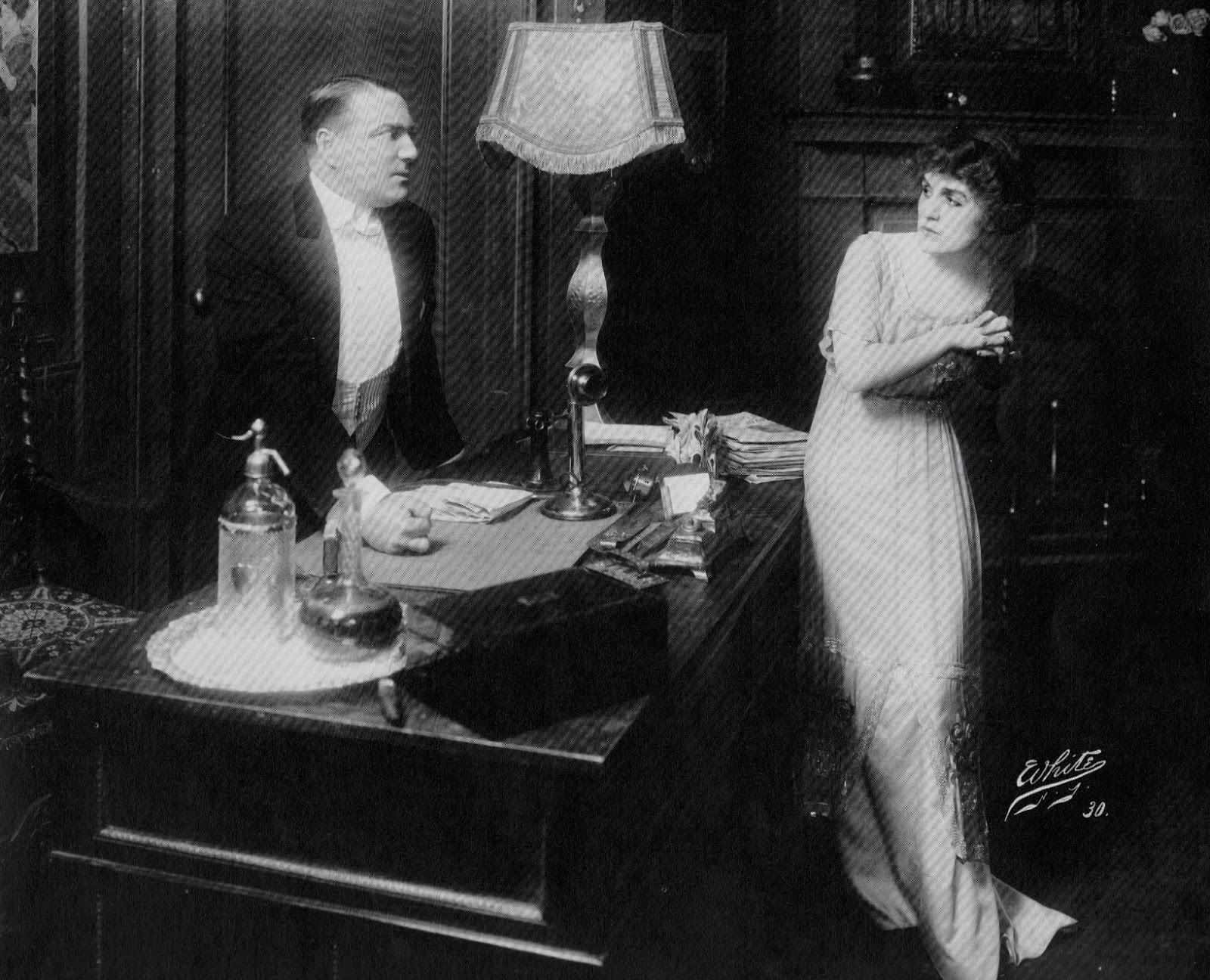
The Boss written by Edward Sheldon and produced at the Astor Theater starring Holbrook Blinn and Emily Stevens in 1911

A scene from The Boss written by the American playwright Edward Sheldon (1886 - 1946) and produced under the direction of Holbrook Blinn (American stage actor 1872 - 1928) and William A. Brady (American theater producer 1863 - 1950), at the Astor Theater, New York, starring Holbrook Blinn and Emily Stevens, having run for 88 performances from January 30, 1911 to April 1911.


Le Vieil Homme written by Georges de Porto-Riche and produced at the Renaissance Theatre, Paris in January 1911

Scenes from Le Vieil Homme (the five-act play of The Old Man, first published in 1911) written by the French playwright Georges de Porto-Riche (1849 - 1930) and produced at the Renaissance Theatre (théâtre de la Renaissance), Paris, in January 1911.