Sunday, 1 September 2013

Typhoon originally produced by Mr. & Mrs. Irving with their company at the Haymarket Theatre in April, 1913

   Scenes from Typhoon (From Melchior Lengyel's "Taifun"), originally produced by Mr. & Mrs. Irving with their company at the Haymarket Theatre, London, from April, 1913 to1914.

   New York Times :  1913/04/03 LONDON, April 2.—An enthusiastic audience gave a great welcome to the adaptation of Melchior Lengyel's “Typhoon,” which was produced at the Haymarket Theatre to-night.


A scene from the play Typhoon at Haymarket theatre. April 1913


The Illustrated Sporting and Dramatic News, April 5th, 1913," "Typhoon," at the Haymarket Theatre.- Mr. Laurence Irving and Miss Mabel Hackney."


The Illustrated Sporting and Dramatic News, April 12th, 1913, "Typhoon" (From Melchior Lengyel's "Taifun") at the Haymarket Theatre."
   a- The Japanese colony in Paris gathered together in the rooms of Takeramo.  The moment these people find themselves alone, freed from the presence of foreigners, they throw off their Western ways, change their dress, draw forward screens, switch off the electric lights, turn and worship the portrait of the Mikado on the wall, and then settle down without the aid of chairs to tell tales of their homes and nation. 
   b- Takeramo (Mr Laurence Irving), who is entrusted with a high and secret mission by his government is questioned as to its nature by his French mistress, Helene (Miss Mabel Hackney).  A little later, goaded by her vulgar insults, he strangles this wretched woman, but his friends insist, for the sake of his yet incomplete work, that a young Japanese named Hironari - who is only travelling for pleasure - must take the blame.
  c- The investigating judge, Benoit (Mr Arthur Whitby), is baffled by the witness Kitamaru (Mr Azooma Sheko), and Hironari's confession is accordingly believed, and a sentence of seven years' imprisonment passed upon him.
  d- At last Takeramo's work for Japan has been finished.  He has handed the manuscript to his compatriots, and has then quietly retired from his friends to the other side of a screen and taken his life as penance for the murder of Helene. The others approve the deed, and are seen seizing upon his papers lest the French police should learn the secrets of Nippon.  A drunken Polish-French poet, Takeramo's friend (Mr Leon Quartermaine), stands stunned at the news.


THEATRE Scenes from 'Typhoon' at the Haymarket, 1913


Friday, 31 August 2012

Scenes from The Amazons written by the English playwright Sir A. Pinero (1855 – 1934), and produced at the Duke of York's Theatre, London, in 1912.

Scenes from The Amazons written by the English playwright Sir A. Pinero (1855 – 1934), and produced at the Duke of York's Theatre, London, in 1912, starring Pauline Chase (1885-1962), etc.


Marie Löhr, Phyllis Neilson-Terry and Pauline Chase in The Amazons. Duke of York Theatre, London. 1912.


The Revival of The Amazons, by Sir A. Pinero, at the Duke of York's Theatre. 1912.


Billie Burke in The Amazons (1913) The play was revived (again with Billie Burke) and opened at the Empire Theatre on 28 April 1913.


Sunday, 29 July 2012

Some scenes from Jim the Penman written by Sir Charles L. Young (1839 – 1887), and performed at the Comedy Theatre, London, in 1912 - 1913.

Some scenes from Jim the Penman written by  the English playwright Sir Charles L. Young (1839 – 1887), and performed  at the Comedy Theatre, London, in 1912 - 1913.


(The Illustrated Sporting and Dramatic News, July 5th, 1913)


Friday, 5 November 2010

Some scenes from Lady Huntworth's Experiment (a three-act comedy) written by R. C. Carton (1853 – 1928), and first presented at the Criterion Theatre, London, by Charles Wyndham, from 26 April to 13 October 1900, running for 163 performances.

Some scenes from Lady Huntworth's Experiment (a three-act comedy) written by the English actor and playwright R. C. Carton (1853 – 1928), and first presented at the Criterion Theatre, London, by the actor-manager Charles Wyndham, from 26 April to 13 October 1900, running  for 163 performances.

This play depicts an aristocrat working under an assumed name as a cook, and finding happiness with a retired military man. 


The Illustrated Sporting and Dramatic News, June 16th, 1900, "Lady Huntworth's Experiment" at the Criterion Theatre."
   a- Act 1.- An Accident. 
Lucy Pillenger (Miss Gertrude Elliott).  The Rev. Mr. Pillenger (Mr. Lewis).
   b- Act II.- The Vicar's Room, Miss Compton.
Keziah (Miss Polly Emery), having dressed herself in her bestm inquires of Caroline Rayward (Miss Compton) whether her dress doesn't "seem to kick up a bit at the back ?"
   c- Act II.
Captain Dorvaston (Mr. Arthur Boutchier) learns to his astonishment, that his drunken acquaintance, Mr. Croyll (Mr. Dion Boucicault is the husband of the Vicar's cook (Miss Compton).
   d- Act III.- "A Spider !" 
Mr. Eric Lewis., Miss Fanny Coleman., Mr. Dion Boucicault.,  Mr. Arthur Bourchier.

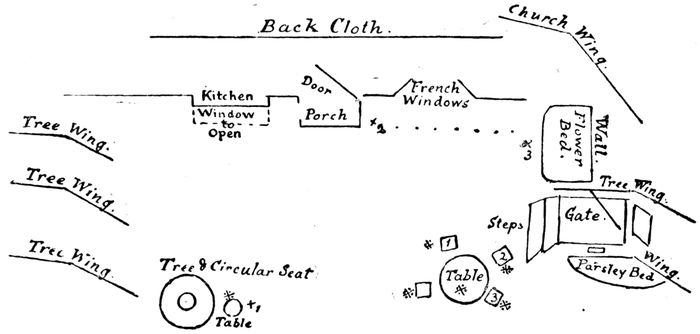
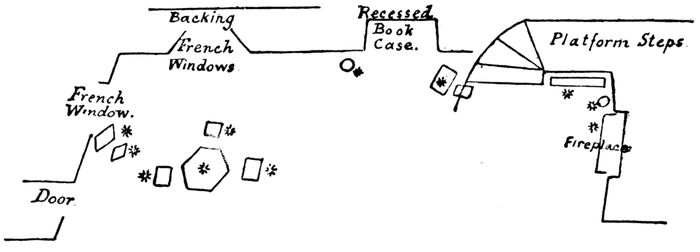
Act I. Scene Plot.

Scene—Back of Vicarage with Garden.

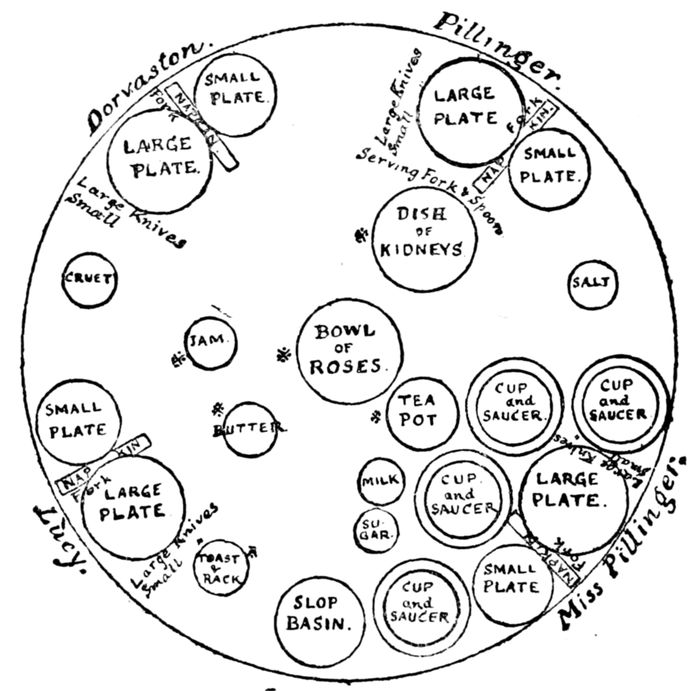
Plan of Breakfast Table.—Act I.

FACING DOWN STAGE.


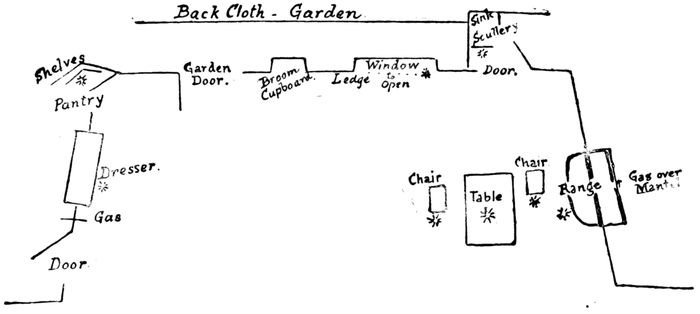
Act II. Scene Plot.

Scene—Vicar's Kitchen.

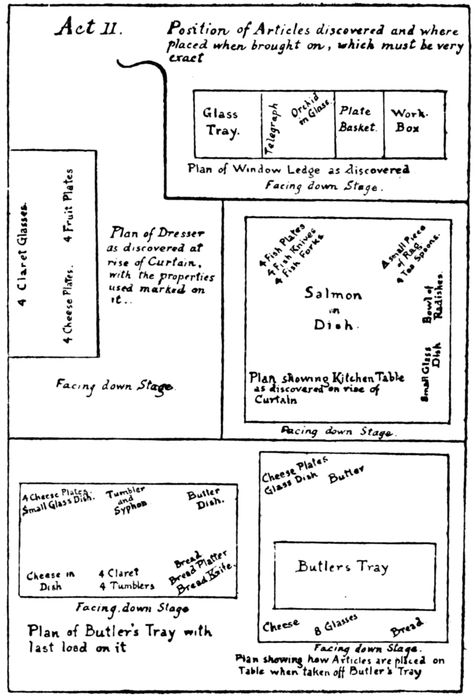
Act II.

Position of Articles discovered and where placed when brought on, which must be very exact

Act III. Scene Plot.

Scene—Vicar's Study.


Original cast
Captain Dorvaston (late Bengal Cavalry) – Arthur Bourchier
Rev Audley Pillenger – Eric Lewis
Rev Henry Thoresby (his curate) – A. E. Matthews
Gandy (manservant at vicarage) – Ernest Hendrie
Newspaper boy – Reginald Denny
Mr Crayll – Dion Boucicault Jr.
Hannah Pillenger (Audley's sister) – Fanny Coleman
Lucy Pillenger (their niece) – Gertrude Elliott
Keziah (housemaid at vicarage) – Pollie Emery
Caroline Rayward (cook at vicarage) – Katherine Compton


Sunday, 3 October 2010

Three scenes from The Prophecy, written by Richard Ganthony (1856–1924), and performed at the Avenue Theatre, London, in 1903.

   Three scenes from The Prophecy,  written by the English playwright Richard Ganthony (1856–1924), and performed at the Avenue Theatre, London, in 1903.

   Richard Ganthony was an actor and playwright. He is best known as the author of the drama A Message from Mars, which premiered in 1899.


The Illustrated Sporting and Dramatic News, March 28th, 1903, "The Prophecy" at the Avenue Theatre."
1- The peasant, David, who has been fascinated and ridiculed by Winelfin, the aristocratic beauty, for her own amusement, breaks out into revolt at her capricious cruelty, and the guests at the castle, regarding the forester as a dangerous savage, approach to attack him.
Mr. Aubrey Mallalieu, as Vlademar.
Miss Constance Collier, as Winelfin.
Mr. Frank Mills, as David.
2- Winelfin befooling her peasant guest, David, with the result shown in our first illustration on page.
Winelfin : "I will put a cap on your head that will teach you more in a minute than i can tell in a year."
3- The twins Daniel and David, discovering that Winelfin has protested her love for each of them, quarrel for the first time in their lives.  Winelfin, whose affection, although genuine enough, is equally divided between the pair, declares, to avoid bloodshed, that she has never loved one or the other, but only made sport of them for her entertainment.          
Daniel  (Mr. Lyn Harding) : "This is a trick to stay our hands."
Winelfin : "It is the truth, to stay your hands."


Tuesday, 4 May 2010

Some scenes from Brown at Brighton (a farce) written by R. Fenton McKay and Walter Stephens, and performed at the Avenue Theatre, London, from 20 December 1902 to 1903.

   Some scenes from Brown at Brighton (a farce) written by R. Fenton McKay and Walter Stephens, and performed at the Avenue Theatre, London, from 20 December 1902 to 1903.

   A farce about a young man going to Brighton to study for his exams, then getting involved with stolen jewels, amorous women, an elopement, etc.

   First performed as Why Brown Went to Brighton The Princess of Wales's Theatre, Kennington, on 5 May 1902 and as Brown at Brighton in the Avenue Theatre, London, on 20 December, 1902.


The Illustrated Sporting and Dramatic News, January 10th, 1903, "Brown at Brighton" at the Avenue Theatre.
1- Miss Ethel Clinton, as Maisie Fairfax.
2- Miss Lettice Fairfax, as Cora.
3- Miss Mabel Garden, as Miss Violet Stapleton.
4- Mr. Dallas Welford as Bertie Brown. (Two Photos)
     a- "I've just come down to study for my exam."
     b- "Oh, why did I come to Brighton?"


Scenes from Brown at Brighton at the Avenue Theatre, 1903


Thursday, 4 February 2010

Some scenes from Officer 666 (A Melodramatic Farce), written by Augustin Machugh (1877-1928), and produced at the Globe Theatre, London, in 1912.

Some scenes from Officer 666 (A Melodramatic Farce), written by the American playwright Augustin Machugh (1877-1928), and produced at the Globe Theatre, London, in 1912.

Officer 666 : "A Melodramatic Farce" by Augustin MacHugh. Various productions (1912 - 14) starring George Nash, Edward Abeles, Percy Ames, Elsie Glynn, Francis McGinn, Wallace Eddinger, Vivian Martin, Alvah D. Simms, Reginald Denny, Ralph Murphy, Albert Roscoe, Ralph Newman, Carson Davenport, Helen Greene, John Arthur, Joseph Allen, etc. Originally produced in 1912 by Cohan and Harris

New York Times : OFFICER 666" IN LONDON.; Is Well Received -- Critics ...
LONDON, Oct. 30.—Augustin McHugh's successful American farce “Officer 666” was presented at the Globe Theatre to-night by Charles Frohman, with Wallace Eddinger as Gladwin and John


The Illustrated Sporting and Dramatic News, November 9th, 1912, "Officer 666," by Augustin Machugh, at the Globe Theatre.
    a- Gladwin, the owner of a New York mansion (Mr. Wallace Eddinger), while disguised as a policeman, witnesses a lovers' interview between the picture thief, Alfred Wilson (Mr. John Miltern) and Helen Burton (Miss Viva Birkett).  Wilson is in Gladwin's own house at the time, is posing as its master, and is about to steal its masterpieces of painting and elope with Helen.
    b- Whitney Barnes (Mr. Sam Sothern) gets handcuffed through a police error, and finds it rather difficult to get at his cigarette case.
    c- Officer 666 (Mr. Dan'l Moyles) arrests Gladwin for the supposed theft of his own pictures, as the word of Wilson, the thief, as to who is actually Gladwin is believed rather than that of Gladwin himself.
    d- Mrs. Burton (Miss Helen Ferrers) recognises Officer 666 (Mr. Dan'l Moyles) as the man whom she saw in his shirtsleeves, and whom she imagines is the thief the police are inquiring for.
    e- Travers Gladwin (Mr. Wallace Eddinger), disguised as Officer 666, discovers Wilson, the picture thief (Mr. John Miltern), at work on his art treasures in his own house. The "Officer" conceals his identity, and affects to assist the "expert."
    f- Wilson, the aesthetic picture thief, has now been exposed, and the police are after him.  He is seen dragging officer 666, with the aid of his servant, and soon after, helped by the very man whom he has personated, the sympathetic Gladwin, he escapes, leaving both the paintings and Helen behind him.